
The Interplay of Lungs and Kidneys in pH regulation
Discover how the lungs and kidneys work together to maintain blood pH—the Interplay of Lungs and Kidneys in pH Regulation &the levels between 7.35 and 7.45. Learn about the quick adjustments made by the lungs and the powerful corrections from the kidneys.
CLINICAL & APPLIED BIOCHEMISTRY
4/4/20262 min read
The Amazing Partnership Between Your Lungs and Kidneys
Have you ever wondered how your body stays healthy despite everything you eat, drink, breathe, and do? One of the most important — yet invisible — balancing acts happening inside you every second is regulating pH.
Your blood must stay within a very narrow pH range: 7.35 to 7.45.
Even tiny changes can affect your brain, heart, muscles, and metabolism.
So how does your body keep this balance?
Two organs work together like a perfectly coordinated team:
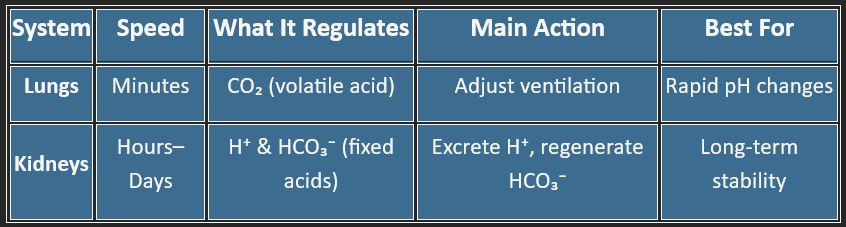
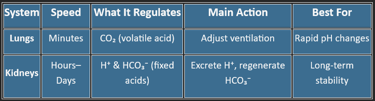
Your lungs — fast responders
Your kidneys — slow but powerful regulators
Let’s explore how they protect your health every moment of your life.
🧪 What Is pH and Why Does It Matter?
pH is simply a measure of how acidic or alkaline something is.
Your body constantly produces acids — from food, exercise, metabolism, and even stress.
If these acids were not controlled, your pH would drop, and your cells would stop functioning properly.
That’s why your body uses three layers of defense:
Buffers — instant chemical stabilizers
Lungs — fast control of carbon dioxide (CO₂)
Kidneys — long‑term control of acids and bicarbonate
This article focuses on the two major players: lungs and kidneys.
The Lungs: Your Fast-Acting pH Protectors
Every time you breathe out, you remove carbon dioxide (CO₂) — a gas that behaves like an acid in your blood.
Here’s the chemistry behind it:
CO₂ + H₂O ⇌ H₂CO₃ ⇌ H⁺ + HCO₃⁻
More CO₂ = more acid
Less CO₂ = less acid
When your blood becomes too acidic
Your brain tells your lungs to breathe faster.
This blows off extra CO₂, reducing acidity and raising pH.
😮💨 When your blood becomes too alkaline
Your breathing slows down.
This retains CO₂, increasing acidity and lowering pH.
⏱️ Speed
Seconds to minutes — the lungs are your emergency response team.
The Kidneys: Slow but Powerful pH Regulators
While the lungs handle quick fixes, the kidneys handle long-term stability.
They regulate pH by:
✔️ Reabsorbing bicarbonate (HCO₃⁻)
This prevents the loss of your body’s main buffer.
✔️ Excreting hydrogen ions (H⁺)
This removes fixed acids that the lungs cannot eliminate.
✔️ Creating new bicarbonate
This helps neutralize acids during illness or metabolic stress.
⏱️ Speed
Hours to days — but the kidneys’ corrections are strong and lasting.
🔗 How the Lungs and Kidneys Work Together
Think of pH balance like maintaining the temperature in your home:
Lungs = quick adjustments (like opening a window)
Kidneys = thermostat (slow, steady, long-term control)
Example 1: Metabolic Acidosis
(Too much acid from diabetes, kidney disease, or diarrhea)
Lungs: breathe faster to remove CO₂
Kidneys: excrete more H⁺ and generate more bicarbonate
Example 2: Respiratory Acidosis
(Too much CO₂ from lung disease or shallow breathing)
Lungs: cannot remove CO₂ effectively
Kidneys: retain bicarbonate and excrete H⁺ to compensate
This teamwork keeps your pH stable even during stress, illness, or intense exercise.
⚠️ What Happens When pH Goes Wrong?
🔻 Acidosis (pH < 7.35)
Fatigue
Confusion
Rapid breathing
Heart rhythm problems
🔺 Alkalosis (pH > 7.45)
Tingling
Muscle cramps
Dizziness
Seizures
Severe imbalances can be life‑threatening and require medical care.
🌟 How You Can Support Healthy pH Balance🌟
You cannot change your blood pH with diet — your body does that automatically.
But you can support the organs that regulate it.
🫁 Support your lungs
Practice deep breathing
Stay active
Avoid smoking
Maintain good posture
🩺 Support your kidneys
Stay hydrated
Limit processed foods
Eat more fruits and vegetables.
Manage blood sugar and blood pressure.
Support your overall metabolism.
Reduce stress
Sleep well
Exercise regularly
These habits reduce the acid load on your body and help your lungs and kidneys work efficiently.
Summary
Your lungs and kidneys are constantly working behind the scenes to keep your pH in the perfect range for life.
The lungs act fast, adjusting CO₂ within minutes.
The kidneys act slowly but powerfully, fine‑tuning acid and bicarbonate levels over days.
Together, they form one of the most elegant and essential partnerships in human physiology.
BLOG
Explore the medical biochemistry intricacies.
WRITE TO US
© 2024. All rights reserved.