
Gout vs Pseudogout: Understanding the Differences
Discover the striking similarities and differences between gout and pseudogout. Learn about symptoms, causes, and treatments for these two forms of arthritis. Get informed on how to manage your condition effectively.
CLINICAL & APPLIED BIOCHEMISTRYPURINE METABOLISM
A K Pannu
5/30/20262 min read
🔥 What Exactly Is Gout?
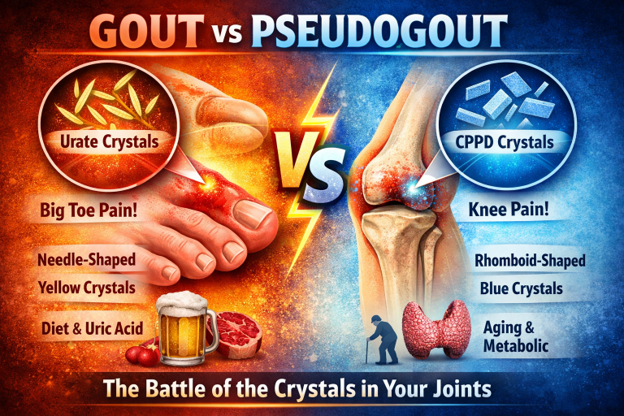
Gout is a type of arthritis caused by uric acid crystals depositing in your joints.
The science in one line
When uric acid levels rise in the blood → crystals form → they settle in joints → inflammation explodes.
Who gets it?
Middle‑aged men
Post‑menopausal women
People with obesity, diabetes, kidney disease
Those who enjoy red meat, alcohol, seafood, sugary drinks
Why diet matters
Foods rich in purines (red meat, organ meat, seafood, beer) increase uric acid.
Your kidneys try to flush it out — but when they can’t keep up, crystals form.
How a gout attack feels
Sudden, severe pain
Swelling and redness
Warm, tender joint
Often starts at the big toe (classic “podagra”)
Can also affect ankle, knee, fingers, elbow
🧬 What medical students should remember
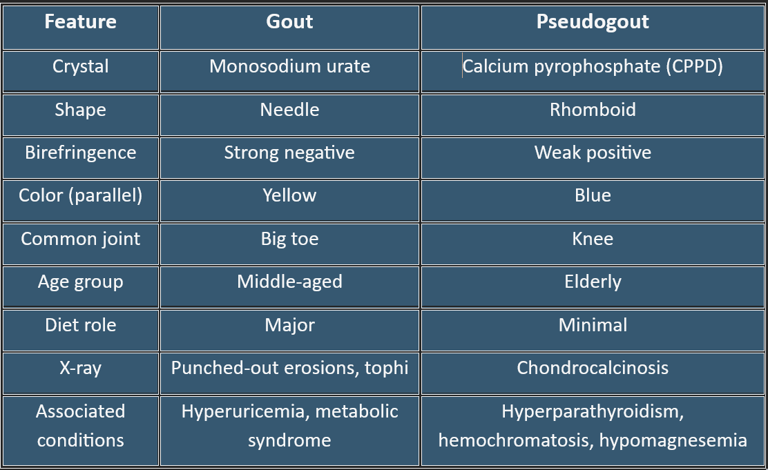
Crystal type: Monosodium urate
Shape: Needle‑shaped
Birefringence: Strong negative
Color: Yellow when parallel to polarized light
Chronic gout: Tophi, erosions, kidney stones
Enter Pseudogout — The Look‑Alike
Pseudogout behaves like gout but is caused by calcium pyrophosphate dihydrate (CPPD) crystals.
Think of it as gout’s cousin who shows up uninvited and causes the same chaos — but for different reasons.
Who gets pseudogout?
Mostly elderly individuals.
It’s strongly linked to aging cartilage and certain metabolic disorders.
Medical causes include
Hyperparathyroidism
Hemochromatosis
Hypomagnesemia
Hypothyroidism
Joint trauma
Osteoarthritis
Chronic kidney disease
🦵 Which joints are affected?
Unlike gout’s love for the big toe, pseudogout prefers:
Knee (most common)
Wrist
Shoulder
Ankle
🧬 What medical students should remember
Crystal type: CPPD
Shape: Rhomboid
Birefringence: Weak positive
Color: Blue when parallel
X‑ray: Chondrocalcinosis (cartilage calcification)
⚔️ Gout vs Pseudogout — The Crystal Showdown
How to Tell Them Apart (Even Without a Microscope)
Clue 1: The Joint Involved
Big toe → Think Gout
Knee → Think Pseudogout
Clue 2: Diet Triggers
Heavy meal + alcohol → Gout attack
No dietary link → Pseudogout
Clue 3: Age
Middle age → Gout
Elderly → Pseudogout
Clue 4: Lab & Imaging
High uric acid → Gout
Chondrocalcinosis on X‑ray → Pseudogout
📝 Conclusion: Two Diseases, One Confusing Story — Now Clear
Gout and pseudogout may look like twins on the surface — sudden pain, swelling, redness — but their causes, crystals, and long‑term management are completely different.
BLOG
Explore the medical biochemistry intricacies.
WRITE TO US
© 2024. All rights reserved.